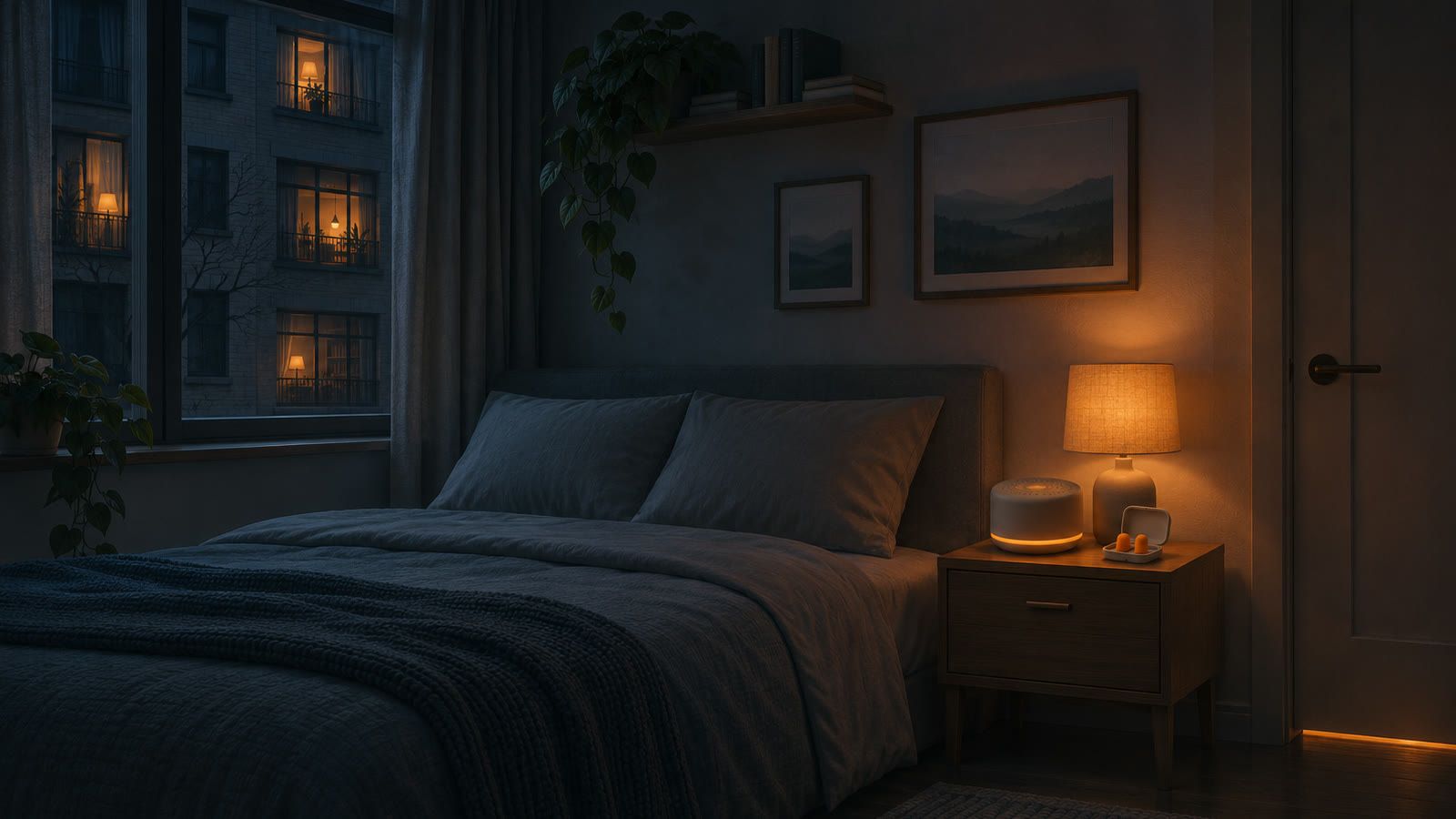
Thunderstorm sounds for sleep that won't wake you up
Why a distant rumble can help you sleep and a close crack wakes you, what to listen for in a storm track, our own measurements, and how to sleep through a real storm.
How this guide was made
Written by Michal Piják, founder of Nightwool. The 22 sources are listed at the end as plain links, and claims about research are checked against the original paper or its abstract wherever we can get it.
Illustrations are AI-assisted. The sound samples come from our app.
We make Nightwool, a sleep-sounds app, so we have an interest in this topic. The app is mentioned only where it's relevant, and there are no sponsored or affiliate links.
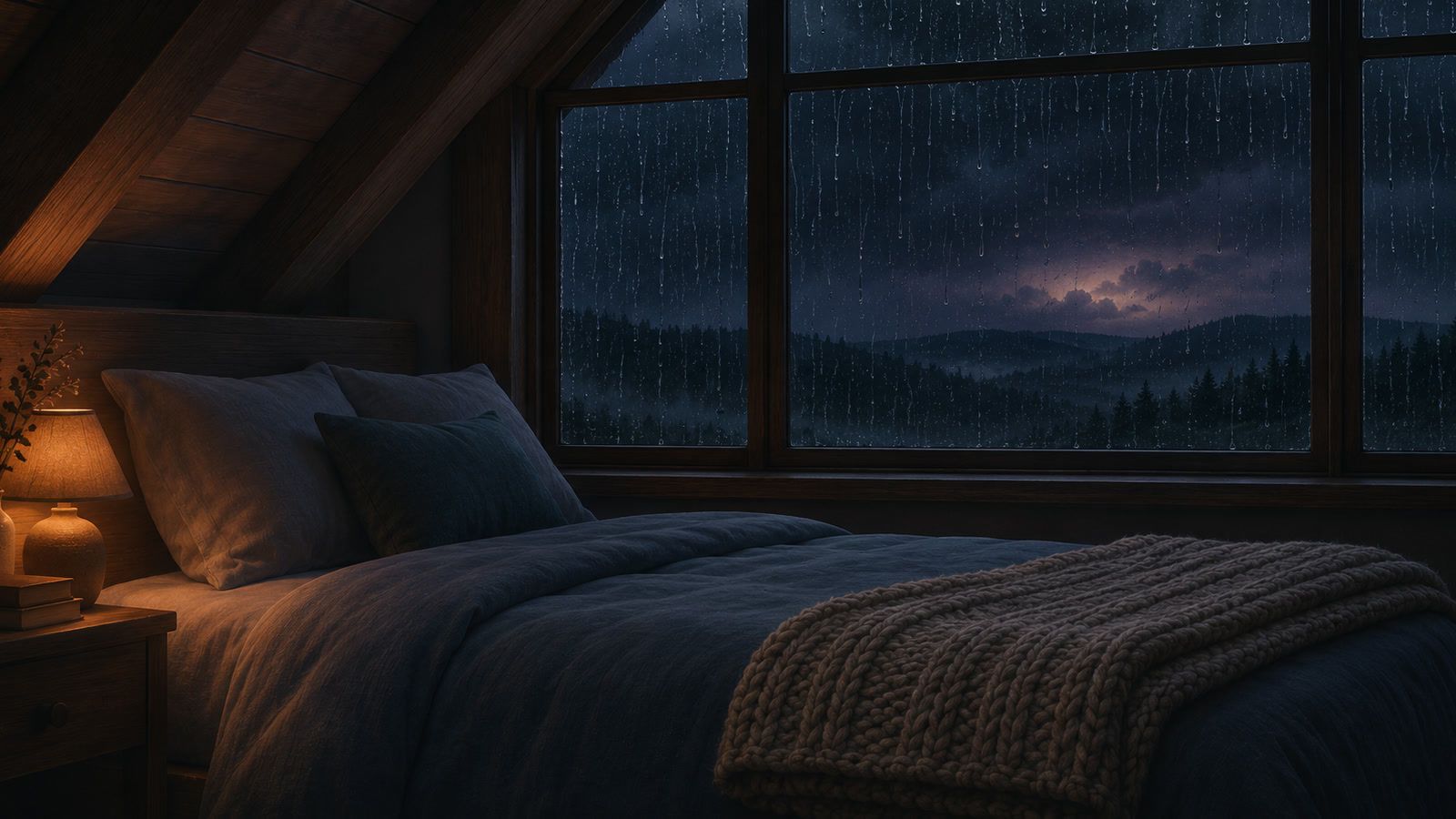
On this page
- Why people fall asleep to storms
- Why thunder can wake you: what the research says
- What thunder sounds like up close and far away
- What to listen for in a thunderstorm track
- We measured our own storm
- Setting up a storm for a whole night
- How to sleep through a real thunderstorm
- The short version
- Questions
- Sources
This article is general information, not medical advice. Nightwool is a sound app, not a treatment. If you have ongoing sleep problems, tinnitus, or concerns about your child, talk to a doctor.
Thunderstorm sounds can help you sleep if the thunder stays in the background. A distant rumble that rolls in slowly and sits just above the rain is easier to sleep through. A close crack that jumps far above everything else in a split second is the kind of sound that wakes people, whether it comes from a real storm or a speaker.
Nobody has studied storm sounds as a sleep aid, so this guide uses what is known about noise and sleep in general, what thunder physically sounds like at different distances, and our own measurements of the storm in our app, Nightwool. At the end: how to sleep through a real storm.
Why people fall asleep to storms
Many people simply like storms. In the reviews we collected for our analysis of 5,014 sleep app reviews, 79 mention thunder or storms, and 47 of those give five stars. Reviewers ask for “light thunder rumbles in background” or more kinds of thunder, and some say it calms them:
“thunder makes me feel calmer.”
Rain Rain review
The likely reasons are ordinary ones. Rain is steady and covers a wide range of frequencies, so it masks other noise, and a storm outside can make a warm bed feel even safer. That second part is a popular explanation that nobody has tested. We cover the rain itself in our guide to rain sounds for sleep.
The same reviews also show the problem:
“while I’m asleep there’s a sudden clap of thunder or crash of a wave that wakes me up”
White Noise Deep Sleep review
Why thunder can wake you: what the research says
The jump matters more than the loudness
Your brain keeps listening while you sleep. A 2001 review describes how the sleeping brain can “automatically detect stimulus occurrence” and react to it when a sound is new enough. Steady sounds stop being new. A sudden one is new every time.
A small 2005 study made this concrete. Researchers played recorded intensive care unit noise to sleeping volunteers. The noise caused about 48 brief arousals per hour, compared with 13 on a quiet night. With white noise added underneath, it fell to about 16.
The authors found that “the change in sound from baseline to peak, rather than the peak sound level” decided whether an arousal happened. Only 5 people took part, and 4 of them had the white-noise night, so treat it as a clue rather than proof.
Peak level, not the average
Larger studies of traffic and aircraft noise point the same way. In the German aerospace centre’s field study used by the World Health Organization, awakenings caused by aircraft started at a peak indoor level of about 35 dB(A) and rose to about a 10 percent extra chance of waking per flight at 73 dB(A).
A 2018 review for the WHO found that the odds of waking rose by about 35 percent for every 10 dB of peak level, for aircraft, road and rail alike.
The WHO’s 2018 guidelines note that average levels “may not be the best” way to explain effects like these, because awakenings from single events are “mostly determined by LA,max”, the maximum level. A storm track can have a pleasant, low average and still contain peaks that wake you.
How fast the sound rises
A 2011 lab study with 72 people compared aircraft, road and rail noise during sleep. Aircraft noise caused significantly fewer brief arousals than road and rail noise, and the authors explained the differences by “sound pressure level rise time” and high-frequency content above 3 kHz. That is traffic, not thunder, and the evidence is limited. It fits the common experience, though: a sound that swells over a second is easier to sleep through than one that arrives as a crack.
What thunder sounds like up close and far away
Thunder changes with distance in exactly the way that matters for sleep. The US National Weather Service explains that as sound travels through air, “the higher pitched sounds are absorbed.” A sharp click, crack or clap means the lightning passed nearby. If the thunder sounds more like a rumble, “the lightning discharge was at least several miles away.”
The rumble itself comes from the length of the lightning channel. A shock wave starts at every point along it, and the sound from different points reaches you at different times, which turns one strike into a long roll. NOAA’s severe weather lab says distant thunder has “quieted to low frequency rumbling”.
So distance gives you everything you want: lower level, no sharp high frequencies and a slower build. Close thunder gives you the opposite.
What to listen for in a thunderstorm track
Before you use a storm recording for a whole night, play it once at bedtime volume while you are awake and listen for these:
- Rumbles, not cracks. You should hear low, rolling thunder. Bright snaps and claps were recorded close to the lightning.
- Thunder close to the level of the rain. Each rumble should rise a little above the rain, not tower over it. If you find yourself turning the volume down for the thunder, it is too loud for sleep.
- A soft start. Each strike should swell in over about a second instead of starting at full level.
- Steady rain underneath. Thunder on its own in a quiet room is a series of loud events separated by silence. The rain fills the gaps.
- No ads and no sudden volume changes. An ad that cuts in at full volume wakes you as surely as a crack. One Rain Rain reviewer drifted off to “rolling thunder” until “an obnoxious extremely loud advertisement popped up”.
- No audible loop. A 30-second storm clip repeats the same strike every 30 seconds, and the brain learns to expect it. Long recordings or apps that vary the playback avoid this.
Long storm and rain videos posted on r/insomnia advertise the same things in their titles: “distant thunder”, “no loud cracks”, “no sudden noises”. Those are the features listeners ask for.
We measured our own storm
Nightwool’s Thunder sound is built from the rain recording plus eight real thunder strikes from a dry storm, played at random moments. Two controls set how often thunder comes and how far away it is. Distance lowers the level, filters out the high frequencies and slows the start of each strike, much like real distance. You can read the details on the thunderstorm sound page.
We wanted to know how far the thunder actually rises above the rain at each setting. We rendered each of the eight strikes over the rain with the app’s own settings and measured loudness in 400-millisecond windows, the momentary loudness measure broadcasters use.
- Distance set to far
- +1 dB
- Default setting
- +3.5 dB
- Distance set to near
- +6 dB
- Typical time for a strike to build up
- ~1 s
At the default setting, a rumble rises about 3.5 dB above the rain (3 to 4.7 dB across the eight strikes). With Distance at far it is about 1 dB, so the thunder is more of a change in texture than an event. Even at near, it stays around 6 dB.
Most strikes take about a second to build from quiet to full level. The quickest takes about a third of a second, so none of them starts as a crack.
Setting up a storm for a whole night
- Start with the rain louder than the thunder. If your app has separate volumes, set the thunder well below the rain. If it has a distance or intensity setting, choose far and calm.
- Keep the overall volume low. Quiet enough that you could still talk over it. Our guide to whether white noise is safe covers volume and speaker distance.
- Add a steady layer if the rain feels thin. A little brown noise or a fan under the rain fills the low end and makes each rumble stand out less.
- Decide what happens after you fall asleep. If thunder sometimes wakes you, use the storm to fall asleep and then switch to plain rain, or use a sleep timer with a slow fade. Sudden silence can wake you too, which we explain in why some people need noise to sleep.
- Put the speaker away from your head. A speaker on the far side of the room or the nightstand, not under the pillow.
How to sleep through a real thunderstorm
A real storm is the same problem with no volume knob. The thunder you can’t avoid is the close kind, but you can lower the jump between background and peak.
- Close windows and curtains. Closed windows cut outside noise, and curtains hide the flashes that come before each crack.
- Play a steady sound. The NHS suggests background sounds like “rainfall, gentle music or white noise” to help you sleep. A steady sound raises the background, so each crack stands out less. This is the same idea as the 2005 study. The 2026 research group also found that pink noise added to intermittent noise reduced REM sleep, so keep any steady sound low.
- Or wear earplugs. In a 2026 lab study of 25 adults, pink noise reduced arousals and awakenings caused by aircraft noise, but it “was outperformed by earplugs”. If the storm is loud, earplugs may do more than any sound. Our article on noisy neighbors compares both.
- Run your phone on battery. The CDC says mobile phones are safe during a storm “if they are not connected to an outlet through a charger.” The National Weather Service advises unplugging electronics before the storm arrives, not while it is overhead. Charge your phone in the evening and let the sleep sound play on battery.
- Count, then let it go. Counting the seconds between flash and thunder tells you how far away the storm is: about 5 seconds per mile, or 3 seconds per kilometre. Thunder can usually be heard up to about 10 miles away (sources range from 20 km to 25 miles). As the gap grows, the storm is moving off.
If your child is afraid of storms
Many children are afraid of thunderstorms. The American Academy of Pediatrics says that with “reassurance and support”, such fears “generally go away on their own”. It advises against belittling them or pressuring a child to be brave. KidsHealth suggests staying calm yourself and putting a flashlight where the child can find it easily. A steady sound in the room can soften the cracks. If a fear lasts and gets in the way of daily life, talk to your pediatrician.
The short version
Pick distant thunder over steady rain, with each rumble only a few decibels above the rain and no sharp cracks. Keep the volume low, test the track while you are awake, and drop the thunder if it ever wakes you. In Nightwool (out now on Android, coming soon to iPhone), that is the Thunder sound with Distance set to far and Storm Rate low, or the Cabin in a Storm mix.
Questions
Are thunderstorm sounds good for sleep?
They can be, if the thunder stays distant and soft and the rain is steady. Nobody has studied storm sounds as a sleep aid, but noise research shows that sudden jumps above the background are what wake people, so close, sharp cracks are the part to avoid.
Why does thunder wake me up when rain doesn't?
Rain is a steady sound. Thunder is an event: the level jumps above the background and the sleeping brain notices the change. A small study found that the size of the jump from background to peak, not the peak level alone, decided whether people woke briefly.
Is it better to listen to thunder with or without rain?
With rain, for sleep. The rain fills the gaps between strikes, so each rumble rises less above the background. Thunder on its own in a quiet room is a series of loud events with silence in between.
Is it safe to use my phone for sleep sounds during a real thunderstorm?
The CDC says mobile phones are safe to use during a storm if they are not connected to an outlet through a charger. Charge the phone before the storm, let the sound play on battery, and don't unplug anything while the storm is overhead.
How can I tell how far away a storm is?
Count the seconds between the flash and the thunder. Sound travels about a mile in 5 seconds, or a kilometre in 3. A sharp crack means the lightning was close; a low rumble means it was miles away.
Sources
- Stanchina et al., “The influence of white noise on sleep in subjects exposed to ICU noise”, Sleep Medicine 2005: https://pubmed.ncbi.nlm.nih.gov/16139772/
- Atienza, Cantero, Escera, “Auditory information processing during human sleep as revealed by event-related brain potentials”, Clinical Neurophysiology 2001: https://pubmed.ncbi.nlm.nih.gov/11682341/
- World Health Organization, Night Noise Guidelines for Europe, 2009: https://iris.who.int/handle/10665/326486
- World Health Organization, Environmental Noise Guidelines for the European Region, 2018: https://iris.who.int/handle/10665/279952
- Basner and McGuire, “WHO Environmental Noise Guidelines for the European Region: A Systematic Review on Environmental Noise and Effects on Sleep”, International Journal of Environmental Research and Public Health 2018: https://pubmed.ncbi.nlm.nih.gov/29538344/
- Basner, Müller, Elmenhorst, “Single and combined effects of air, road, and rail traffic noise on sleep and recuperation”, Sleep 2011: https://pubmed.ncbi.nlm.nih.gov/21203365/
- Basner et al., “Efficacy of pink noise and earplugs for mitigating the effects of intermittent environmental noise exposure on sleep”, Sleep 2026: https://pubmed.ncbi.nlm.nih.gov/41627391/
- Basner et al., “The efficacy of pink noise and earplugs for mitigating sleep disruption induced by different environmental noise sources”, Sleep Health 2026: https://pubmed.ncbi.nlm.nih.gov/42120238/
- Riedy et al., “Noise as a sleep aid: A systematic review”, Sleep Medicine Reviews 2021: https://pubmed.ncbi.nlm.nih.gov/33007706/
- National Weather Service, Dr. Lightning’s guide, the science of thunder: https://www.weather.gov/media/safety/Dr_Lightning_Guide-science.pdf
- National Weather Service, how thunder is produced: https://www.weather.gov/source/zhu/ZHU_Training_Page/lightning_stuff/lightning2/thunder.html
- NOAA National Severe Storms Laboratory, Severe Weather 101: Lightning: https://www.nssl.noaa.gov/education/svrwx101/lightning/
- Met Office, thunder and lightning: https://weather.metoffice.gov.uk/learn-about/weather/types-of-weather/thunder-and-lightning
- National Weather Service, thunder: https://www.weather.gov/safety/lightning-science-thunder
- National Weather Service, indoor lightning safety: https://www.weather.gov/safety/lightning-indoors
- National Weather Service New York, Lightning Safety Awareness Week: https://www.weather.gov/okx/LightningSafetyAwarenessWeek
- CDC, lightning safety FAQ: https://www.cdc.gov/lightning/faq/index.html
- NHS Every Mind Matters, how to fall asleep faster and sleep better: https://www.nhs.uk/every-mind-matters/mental-wellbeing-tips/how-to-fall-asleep-faster-and-sleep-better/
- American Academy of Pediatrics (HealthyChildren.org), understanding childhood fears and anxieties: https://healthychildren.org/english/health-issues/conditions/emotional-problems/pages/understanding-childhood-fears-and-anxieties.aspx
- KidsHealth, “Storm Stress: Helping Kids Stay Calm”: https://kidshealth.org/ArkansasChildrens/en/parents/storms-calm.html
- Reddit r/insomnia, “12h distant thunder + pure rain for cozy storm sleep. No loud cracks”: https://www.reddit.com/r/insomnia/comments/1p6yok9/12h_distant_thunder_pure_rain_for_cozy_storm/
- Reddit r/insomnia, “10-Hour Gentle Rain on Window for Sleep | No Thunder, No Sudden Noises”: https://www.reddit.com/r/insomnia/comments/1qx1w2s/10hour_gentle_rain_on_window_for_sleep_no_thunder/
Sounds from this article